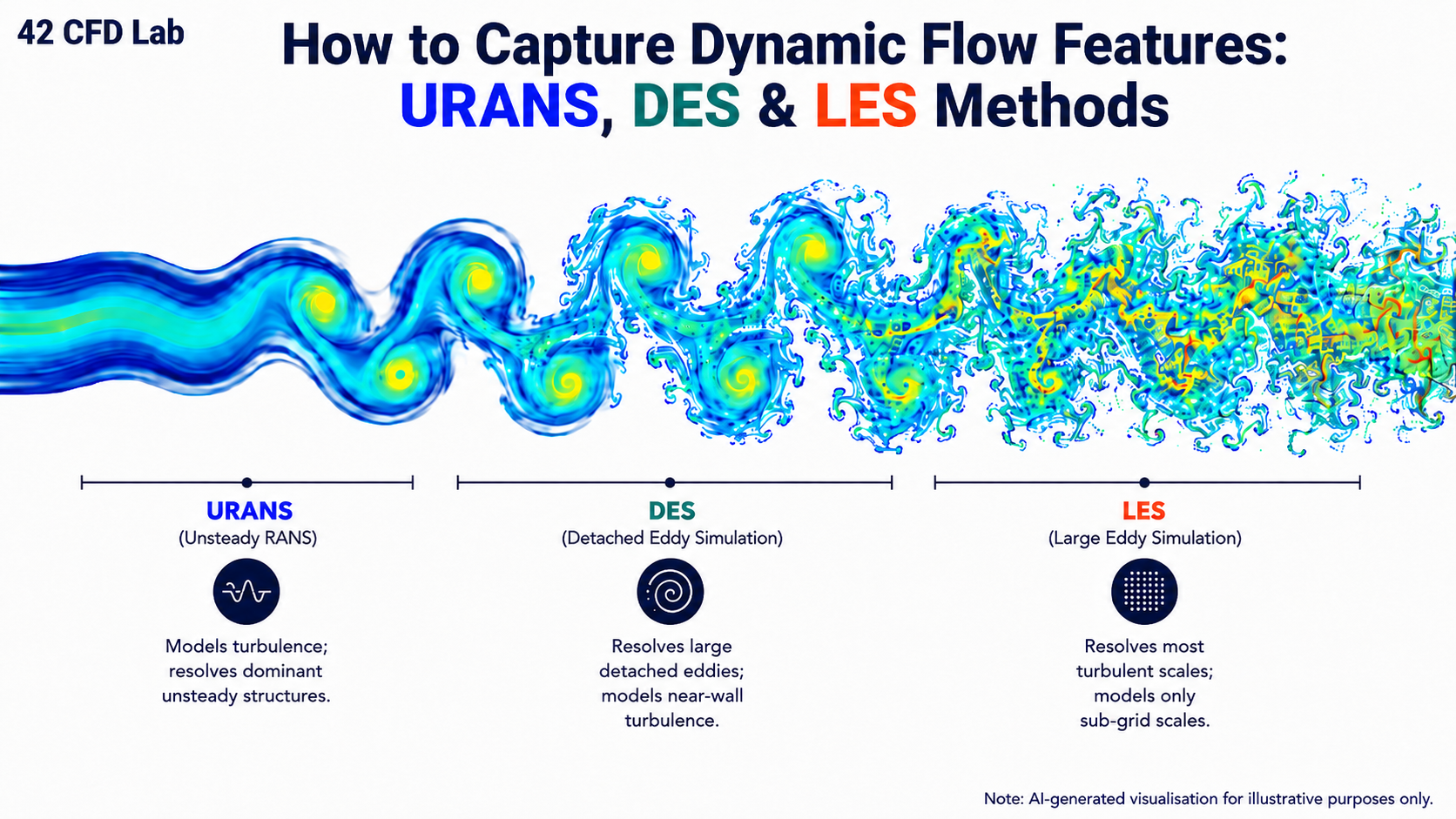
How to Capture Dynamic Flow Features: URANS, DES & LES Methods
URANS, DES, and LES each have distinct strengths and are designed for different levels of flow complexity.URANS remains the industry workhorse for efficient engineering analysis, DES provides an excellent balance between computational cost and predictive accuracy for complex separated flows, and LES delivers the highest-fidelity representation of turbulence when detailed flow physics are essential. Selecting the right method ultimately depends on the flow physics, computational resources, and the level of detail required, balancing predictive accuracy against computational cost.
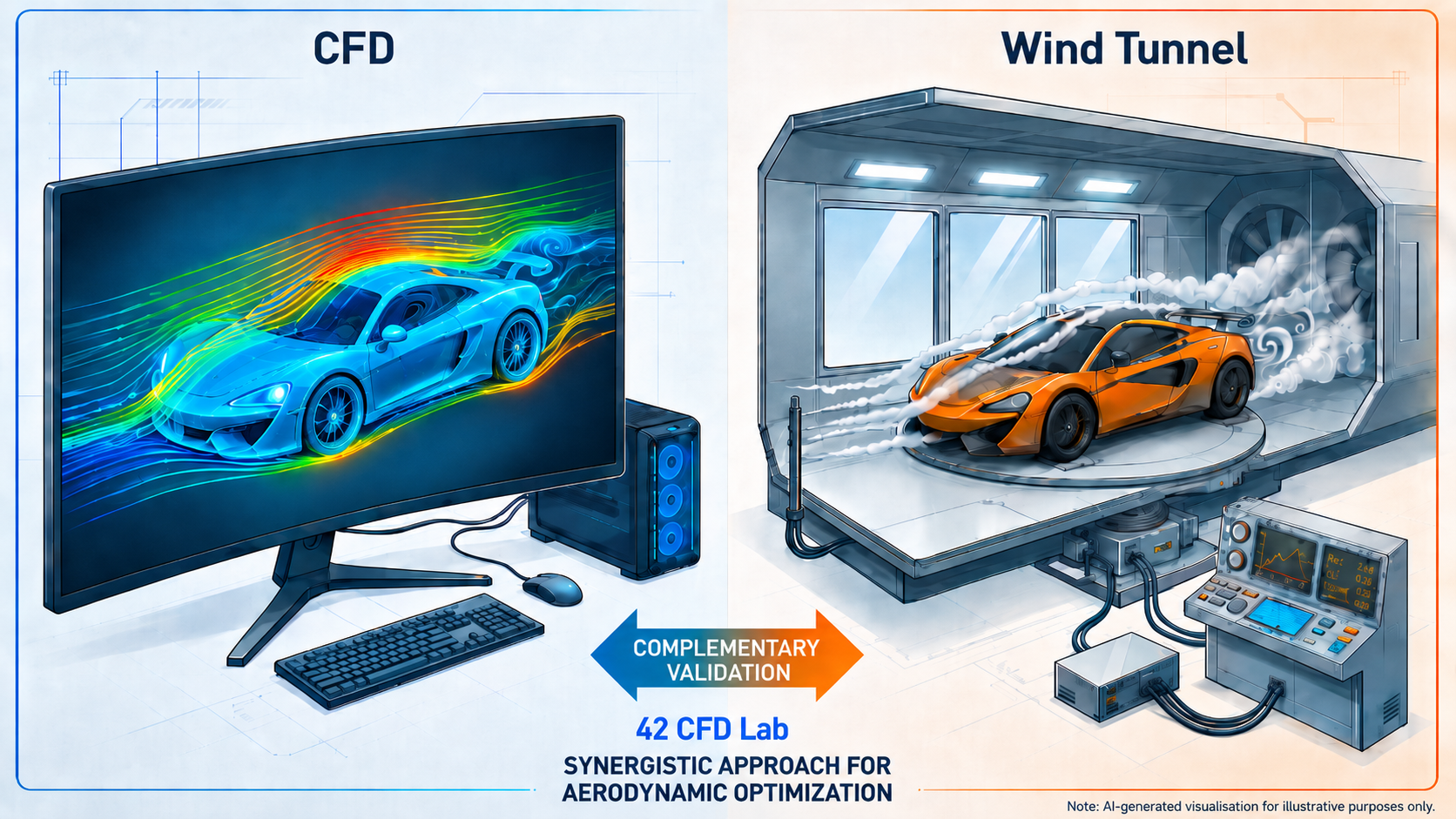
CFD vs Wind Tunnel: Which One Should I Use?
At 42 CFD Lab, we recognise that CFD simulation and WT testing are not mutually exclusive; they are complementary. CFD is ideal for rapid design exploration, enabling engineers to evaluate hundreds of design iterations, optimise performance, and understand flow physics quickly and cost-effectively. Wind tunnel testing complements CFD by providing high-confidence experimental validation for final design verification and certification. While CFD offers speed and low-cost iteration, wind tunnels deliver the highest level of physical accuracy. The most effective approach is to use CFD early and throughout the design process, then validate the final optimised design with wind tunnel testing.
Practical Guidance on RANS Turbulence Model Selection for Bluff-Body Aerodynamics
Turbulence modelling remains one of the most challenging aspects of industrial CFD. No turbulence model is universally perfect for bluff-body flows. For most industrial bluff-body simulations, the SST k-ω model is the default choice: it consistently provides the best balance of accuracy, robustness, and computational cost. Spalart–Allmaras and k-ε variants are useful for quick scoping studies of attached-flow cases, and Reynolds stress models can be tried for very complex 3D separations, but neither will generally outperform SST in a first-pass analysis.